Processed Samples
250
Self-annotated in CVAT before training.
Microscopy Image Analysis
A microscopy detection pipeline and offline desktop app that count pico-algae cells from paired brightfield and fluorescence image channels — in daily use at the lab bench.
An end-to-end deep learning workflow for detecting and counting pico-algae in microscopy imagery, now shipped as an offline desktop app that colleagues run at the microscope. The core model is a custom 6-channel Faster R-CNN that fuses paired microscope images; around it sit training, tuning, and post-processing sweeps, plus a local review UI where corrected detections are exported straight back into training data.
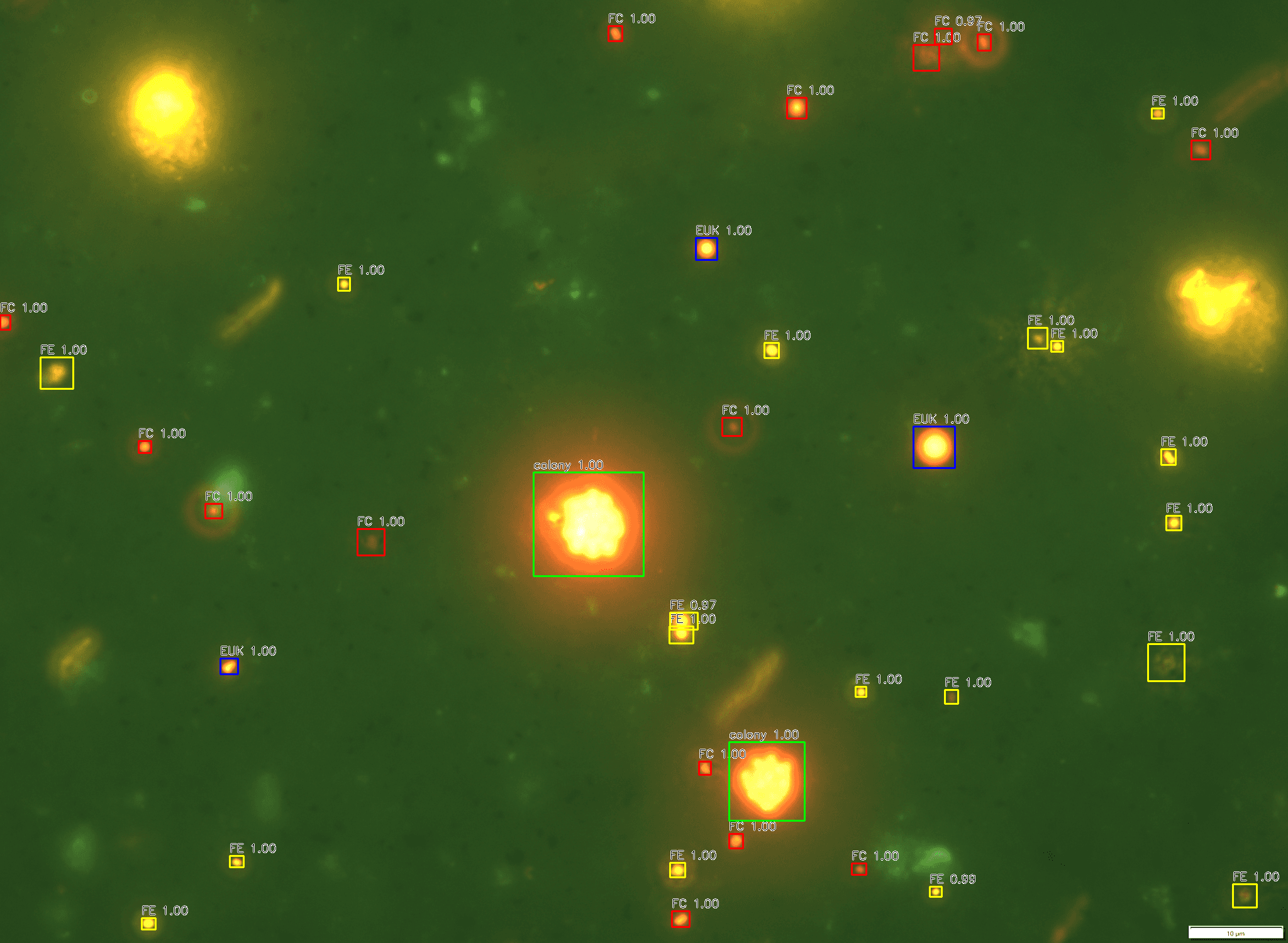
The project is built around dense small-object detection, where manual counting is slow and subject to variability. It targets paired microscopy captures and predicts cell-level boxes for four foreground classes: `Eukaryote`, `Phycoerythrin`, `Phycocyanin`, and `Colony`.
The repository includes data preparation scripts, manifest generation, image resizing to a fixed 2048x1500 format, annotation sanity checks, training and inference entrypoints. The dataset was self-annotated in CVAT before being converted into the training format used by the detector.
The modeling work goes beyond a default detector setup. The Faster R-CNN backbone is patched from 3 input channels to 6 so the network can ingest both image channels together, and the repo includes separate sweeps for model settings and post-processing thresholds.
Saved outputs show that the project is not only a training prototype but also an analysis workflow: example detections, debug overlays, EDA plots, and tuning CSVs are all present in the repository.
The project now ships as a desktop tool: a one-click installer sets up a local web app where users drag in images (or capture them straight off the Olympus microscope software), get per-class counts with annotated previews, correct the detections in an interactive editor, and export everything to CSV. It runs fully offline on the lab PC.
Corrections close the loop: the editor's training export writes reviewed images and fixed boxes in the exact format the trainers consume, so routine lab use continuously grows the training dataset.
Manual pico-algae counting in microscopy images is slow and error-prone.
Cells are small, dense, and sometimes overlapping, which makes classical counting brittle.
The workflow needs to use paired differently painted microscopy images rather than a single RGB frame.
Counting quality depends not only on training but also on score thresholds and NMS settings in crowded scenes.
Built the training and batch inference workflow around a Faster R-CNN detector in PyTorch.
Adapted a ResNet50-FPN Faster R-CNN backbone from 3-channel input to a 6-channel fusion model for paired microscopy images.
Implemented dataset indexing, pair discovery, preprocessing, self-annotation workflow in CVAT, annotation conversion, and visualization utilities.
Added evaluation code focused on count-based metrics and ran separate tuning sweeps for model settings and post-processing.
Built the desktop app around the model: a Flask-based local web UI with drag-and-drop analysis, an interactive box editor (draw, move, resize, reclassify, per-colony cell counts), CSV export, and a Windows installer with launcher scripts.
Added a screen-capture workflow that grabs the live image region from the Olympus microscope software, runs detection on it, and collects captures into a single review tab — no file export step needed.
Preprocessed raw microscopy pairs into a consistent 2048x1500 WEBP dataset and rescaled bounding boxes into absolute-pixel labels.
Annotated the dataset in CVAT and converted those labels into the detector-ready training format.
Validated dataset integrity with manifest generation and sanity checks for missing pairs, missing labels, and image-size mismatches.
Trained a 6-channel Faster R-CNN (ResNet50-FPN) initialized from COCO weights with an expanded first convolution layer.
Evaluated the detector using count-based metrics such as count MAE, RMSE, and bias, with optional class filtering.
Tuned anchor settings, backbone depth, learning rates, detection caps, score thresholds, and NMS thresholds through saved sweep configs and CSV outputs.
Finished and in use: colleagues run the desktop app daily to count pico-algae in their own microscopy data — dragging images in or capturing them straight from the microscope, reviewing detections, and exporting counts to CSV.
Corrections made during routine use are exported as new training data, so the dataset — and the model — keep improving as a side effect of normal lab work.
The repository contains a complete reproducible workflow from dataset preparation to batch prediction visualizations.
The processed training index contains 250 paired image samples in a self-annotated CVAT dataset with 16,181 labeled boxes.
A saved 5-fold training sweep reached a best mean count MAE of 3.94 before post-processing optimization.
A saved 5-fold post-processing sweep reduced the best mean count MAE to 2.42 with a standard deviation of 0.50.
Example outputs, EDA plots, debug overlays, and batch prediction renders are all included as inspectable artifacts.
Processed Samples
250
Self-annotated in CVAT before training.
Labeled Boxes
16,181
Best Count MAE
2.42
Foreground Classes
4
Eukaryote, Phycoerythrin, Phycocyanin, Colony.
Outputs and diagrams from the project.
Pipeline diagram for the pico-algae workflow.
Additional pico-algae detection output.
Additional pico-algae detection output.
Predicted detections on a microscopy sample.
Saved figures and chart artifacts referenced by the project.
Object count distribution per image.
Bounding-box width distribution.
Bounding-box height distribution.
Distribution of labeled bounding boxes across the four foreground classes in the training dataset.
Compares the best saved result from model-configuration tuning against the best saved post-processing sweep.